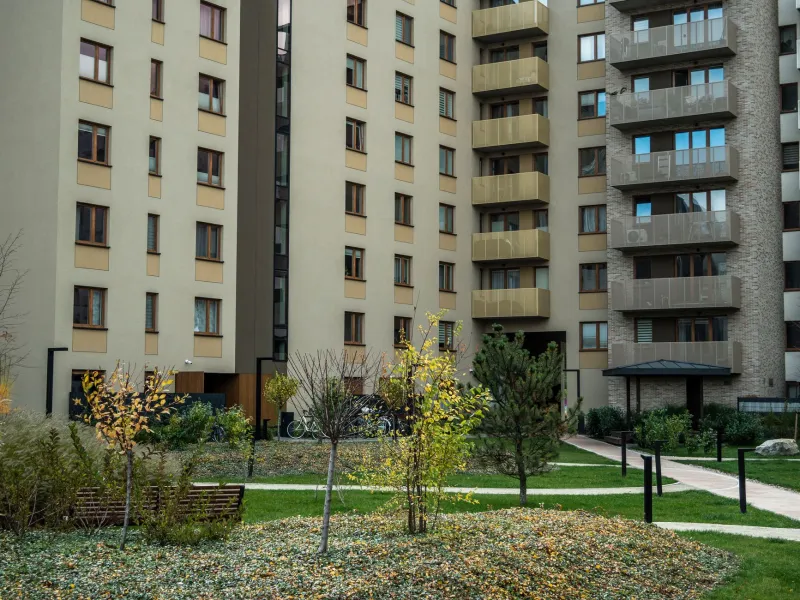
When Home and Work Share the Same Zip Code: The Surprising Ways Short Commutes Remake Your Entire Life

Most people calculate commute costs in two currencies: money and time. Fuel, transit passes, parking—these figures are concrete and easy to quantify. The lost hours are similarly straightforward arithmetic. But there is a third dimension to the commute equation that almost no one measures at the moment of lease signing, and it may be the most consequential of all: the way that physical distance between home and workplace quietly restructures every hour you are not at work.
When proximity collapses that distance—when the office is a ten-minute walk rather than a forty-five-minute drive—something more fundamental than a schedule adjustment takes place. Behaviors change. Relationships shift. The architecture of a typical week begins to look entirely different. Understanding those changes in advance is one of the most valuable things a prospective resident can do before choosing where to live.
The Hours That Disappear—and What Fills Them When They Return
The American Community Survey has consistently documented that the average one-way commute in the United States runs somewhere between 27 and 30 minutes. That figure sounds manageable in isolation. Compounded across five working days and both directions, it represents roughly four and a half hours per week—or the equivalent of nearly ten full working days per year—spent in transit.
When those hours are returned to a resident through a dramatically shorter commute, they do not simply sit idle. Research on time-use behavior consistently finds that recovered commute time flows into three primary channels: sleep, physical activity, and social investment. These are not trivial reallocations. Each one carries compounding effects on health, productivity, and overall life satisfaction that extend well beyond the obvious convenience of a shorter drive.
Sleep, in particular, responds quickly to commute reduction. Studies examining shift workers and office employees alike have found that individuals who shorten their commute by thirty minutes or more report measurable improvements in sleep duration and perceived sleep quality within weeks. The mechanism is straightforward: when the morning alarm no longer needs to account for an extended transit window, bedtimes shift later without sacrificing rest, and the cortisol spike associated with traffic stress no longer interrupts the final phase of sleep.
Exercise as a Beneficiary of Reclaimed Time
Among the behavioral changes most reliably associated with short-commute living, physical activity stands out as both consistent and significant. This is not simply because residents have more time available. It is because proximity to work tends to enable what exercise scientists call "incidental activity"—movement that is woven into the daily routine rather than scheduled as a discrete event.
A resident who walks or cycles to work is accumulating cardiovascular benefit before the workday begins. The same resident, returning home with energy intact rather than depleted by a long drive, is far more likely to take an evening run, use a building fitness center, or walk to a nearby restaurant rather than defaulting to delivery. The behavioral pattern reinforces itself: shorter commutes reduce fatigue, reduced fatigue lowers the activation threshold for physical activity, and consistent physical activity further improves energy and mood.
For residents evaluating apartment communities, this suggests that proximity to employment is not merely a schedule convenience. It is, in a meaningful sense, a health infrastructure decision.
Social Patterns and the Geography of Relationships
Long commutes impose a particular kind of social tax that rarely appears in any housing budget. When a significant portion of the evening is consumed by transit, the hours available for maintaining friendships, deepening romantic partnerships, and participating in community life contract accordingly. Researchers studying the relationship between commute length and personal wellbeing have found that each additional ten minutes of daily commuting is associated with measurable reductions in social connectedness and reported life satisfaction.
The inverse holds as well. Residents living close to their workplaces report spending more time with friends and family, greater participation in neighborhood social life, and stronger ties to their immediate residential community. Part of this is simply arithmetic—more discretionary time enables more social investment. But part of it is geographic: when home and work occupy the same neighborhood, the social ecosystem of each begins to overlap. Colleagues become neighbors. Local businesses become shared gathering spaces. The boundaries that long commutes enforce between professional and personal life become more permeable in ways that many residents find genuinely enriching.
The Psychological Shift That Follows Physical Proximity
Beyond the behavioral changes, there is a subtler psychological dimension to short-commute living that deserves attention. Commuting—particularly in congested urban environments—is one of the few daily activities that research consistently identifies as resistant to adaptation. Unlike other sources of stress, the frustration of a difficult commute does not diminish significantly over time. Most people do not habituate to traffic. The negative emotional residue of a long drive or a delayed train tends to arrive home with the commuter, coloring the early hours of the evening and making genuine rest more difficult to achieve.
Eliminating or dramatically reducing that experience changes the emotional baseline from which a resident begins each evening. The person who walks five minutes from office to front door arrives home in a fundamentally different psychological state than the person who has spent forty minutes in stop-and-go traffic. That difference in baseline affects everything that follows: the quality of conversations, the patience available for domestic responsibilities, the capacity for genuine leisure rather than mere decompression.
Weekends and the Expansion of Possibility
The effects of workplace proximity are not confined to weekday evenings. Weekends, too, are reshaped by the decision to live close to work—though in less obvious ways. For residents with long commutes, weekends often carry an implicit obligation to recover from the week's accumulated fatigue before engaging in anything genuinely restorative. The first day of the weekend becomes a buffer rather than a beginning.
For residents whose commutes impose minimal stress and time cost, this recovery buffer shrinks considerably. Weekends expand in functional terms—not because the calendar changes, but because the resident arrives at Saturday morning with more energy, better sleep, and fewer hours of deferred domestic tasks to address. The result is a qualitative shift in how discretionary time actually feels and what it makes possible.
Choosing a Residence With Proximity in Mind
For prospective residents weighing their options, these findings carry a practical implication: the distance between a potential home and a primary workplace deserves to be treated as a first-order consideration rather than a logistical footnote. The apartment with a slightly higher monthly rent that places a resident within walking distance of their office may deliver a return—in sleep, health, relationships, and daily quality of life—that no amenity package can replicate.
At Fairlane Residences, the communities we feature are selected with precisely this calculus in mind. Location relative to employment centers, walkability, and access to the texture of daily neighborhood life are not afterthoughts in how we evaluate a development's value to its residents. They are central to the proposition that the right home does not merely shelter you—it actively enables the life you intend to live.